From the book “Od rowerzysty do kolarza” · 2023
In Polka Dots and Rainbow Stripes
Interview by Katarzyna Ślęzak
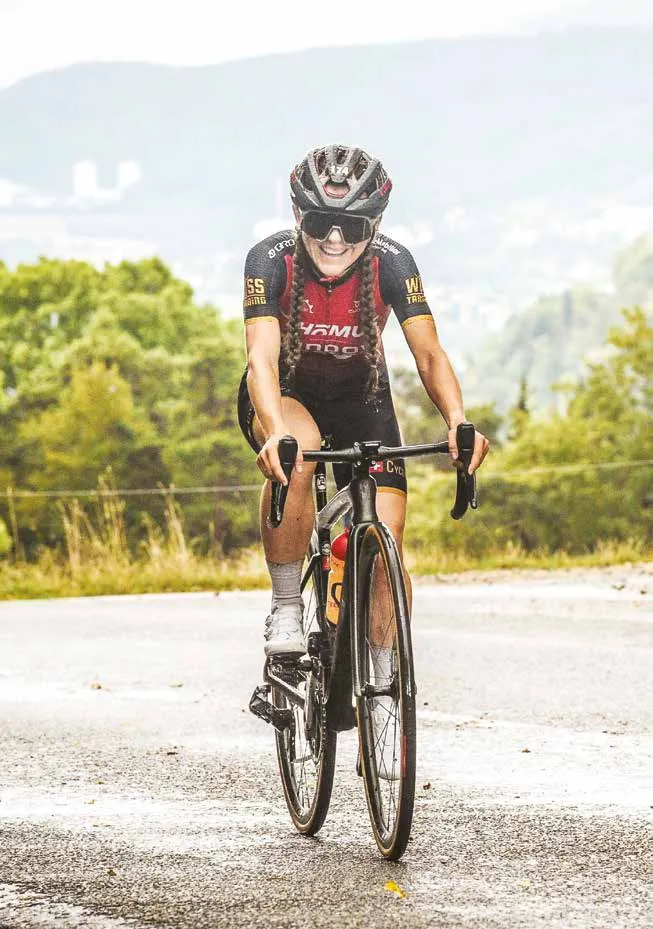
Alina Myłka is a walking (or rather riding) inspiration. She recently became a mother and is already back in shape and racing. In 2021 she became a double UCI Gran Fondo amateur world champion in Sarajevo. She also has many wins in ultramarathons in Switzerland, where she lives and trains day to day. She is one of the people who have worked with Arek the longest. Together they went from almost zero to such impressive results. Who is the woman whose wheel most men at training camps cannot hold?
You’ve just come back from the UCI Gran Fondo World Championships for amateurs in Scotland, where you finished 5th. That is of course an impressive result, and congratulations, but I imagine you went there for another gold.
When I saw the start list, I already knew it would be really hard. Here everyone rides for themselves, even the Polish women chase you, nobody waits for anybody. There were a lot of less experienced girls pushing their way to the front, and the last 5 km to the finish were very nervy; one of them even bumped into me, which at the speed we were doing in the finale was simply extremely dangerous. On the last stretch to the finish the road was very narrow. On top of that there was chaos at the feed zone, I couldn’t find my bearings and lost quite a lot of time there. While I was looking for my husband Antek, the girls got away from me.
You missed out on victory by very little, just 3 seconds. What did you feel at the finish?
On the whole I don’t hold a grudge about the championships; it’s more that I was left wanting more, because I’m convinced I was very well prepared, but I think I lacked intuition and tactical fight on that last stretch. I started wondering whether I could have done something better, but there was simply no way to ride it better. I’m not disappointed; maybe I just have a slight grievance with the organisers that this finish wasn’t on a wider road. Maybe it would have been better if the women’s categories had been separated, because we started together and girls from the younger category blocked me from fighting it out in the sprint with the girls from my category, so there was this strange chaos at the finish.
And how do you feel today, now that the emotions have settled a bit?
I think I’ll find a new goal very quickly and focus on it. Even if I had won these championships, I would still be looking for a new goal. I need to have some concrete point on the programme in the near future to be able to function. I’m happy, because I rode well, even though I’m still a breastfeeding mother, constantly short of sleep. And it gives me enormous satisfaction that after a year’s break I managed to get back to the level I was at before my pregnancy.
Do you feel you’re an inspiration for other women? In my opinion you undoubtedly are.
Sometimes I meet someone who makes me realise that I’m a motivation for them, and that’s very nice. Though I do it for myself. I think every person needs to have something of their own, something that helps them grow. I aim for my work to be satisfying, and usually it is, but the time when I go out training is a moment for me, when I can quieten down and calm myself, so that afterwards I can work at full throttle. Those are the reasons I started cycling.
Will you tell us about that beginning? How did your cycling adventure start?
My cycling adventure started back in Poland. I bought a bike, an MTB at the time, to commute to work instead of driving, and I noticed that I simply enjoyed it and that because of it everything else in my life was going much better, and I felt much better too. I got more and more hooked – it’s amazing that this sport has such a positive effect on me. Cycling takes up a big chunk of my time, but I use the time I have left much better than I would if I didn’t train.
You went from buying a bike to your first race very quickly, didn’t you?
Yes, when I started cycling to work, my colleagues were already racing in various events. At the time I didn’t think about it; in fact I resisted tooth and nail whenever they suggested it. But they wanted to enter a marathon as a team and talked me into riding with them. I started, although I had no idea what I was getting myself into. It was 60 km and 2,000 metres of climbing, and all I’d ever done was ride to work. I reached the finish last, I think I rode for 6 hours, I was exhausted, my whole body ached, I couldn’t even smile because literally everything hurt. But I had never felt as many emotions as I experienced at that race, and as much as I had resisted it, that’s how much I liked it. The competition and the satisfaction of finishing the race won me over – I thought: I’m in.
And you started training?
I remember that right after that race I bought the book The Mountain Biker’s Training Bible by Joe Friel. Thanks to it I learned the basics of training; I found out that you need to do endurance training and strength exercises too. And based on that book I put together my first makeshift training plan myself. Later I bought a road bike, and that coincided with moving to Switzerland. There I quickly noticed during training that much older men, grandpas, were overtaking me, so I decided I had to improve my training programme. That’s when I turned to Arek – it was 2014, the beginning of structured training. We started with aerobic training and basic monthly plans. We saw a real improvement a year later, when we switched to weekly plans with power measurement.
You could say you started working with Arek from scratch, and a moment later you became world champion. How much time passed before the first significant results came?
It’s hard for me to say now, because before I started racing on the road, I took part in MTB races. There technique counts a lot, and it was unrealistic for a coach I only talked to remotely to teach it to me. And at that time in Switzerland I didn’t have a group I could train with and learn from. It was different in Poland, because there I had my work colleagues and I knew as much as I’d managed to pick up during group rides with the guys. That’s why in those first 2 years I didn’t manage to get on the podium, but after a knee injury I picked up skiing, I came up with the idea of coming to Poland for the Tatra Road Race and racing on the road. I didn’t have big expectations, but it turned out I beat everyone by almost half an hour. That was my first podium and my first win. I was very surprised, but I decided to give up MTB in favour of the road bike. That’s how the harder training and the first noticeable results began.
What is it like to live and train in Switzerland? What does it look like from the perspective of a woman on the road?
It’s hard for me to compare it with Poland, because I really only started riding in Switzerland. But as far as Switzerland goes, the conditions for training here are excellent. There are lots of cycle paths, loads of amazing passes with beautiful views, smooth tarmac, small and big climbs. There are a lot of cyclists, and cars are very careful around cyclists; they don’t squeeze past when there’s oncoming traffic. The fines for drivers who break the rules are very high, so that also motivates them to follow them. Thanks to that, cyclists feel safe on the roads. Another plus is that when the weather is bad in winter, I take the train to the other side of the Alps and the weather there is always good. I live in Bern; the weather here changes quickly, so when I go out training I have to be prepared for anything. As for women, of course men dominate among cyclists, but there are plenty of women too. Most of them don’t race at elite level but compete in amateur races. That’s why the level of the women racing in them is very high.
I’m curious whether you always train alone. Do you prefer training on your own or riding in a group?
Before giving birth I tried to ride in a group as much as possible, but now unfortunately it’s almost impossible because I’m still breastfeeding. And I think that’s my biggest pain at the moment, because I don’t like riding alone. I enjoyed it when my cycling was more social. People often suggest we do a session together, but usually we can’t make our schedules match. I’m in a cycling club of about 30 members, and it’s also hard to find time to train together now. There are a few races in which almost all of us from the club take part, and then we have great support in each other. We were also together at a camp in Gran Canaria, and I managed to go on a few training camps with Arek, so I know that I feel best when training in a bigger group. I think I’ll gradually return to training with other people, but for now I mostly ride alone and the distances are shorter. Before my pregnancy I raced ultramarathons, so a single training ride lasted 7–8 hours in the mountains.
Your form and endurance are impressive. You recently won a race with a total elevation gain of almost 5,000 m. What motivates you to push past your own limits?
That’s actually a very interesting question, because when I’ve been riding for several hours and everything hurts, I wonder myself why I’m doing it. For me it’s an adventure; I think I simply like that state. I remember that before my first long-distance races my husband kept saying I wouldn’t manage. But I managed, and I even made the distances longer. After a race of 300 km with 8,000 m of climbing he stopped saying that. I think that’s just how I am: in races lasting several hours I have a better chance than over short distances. I was 6th in the open category then; I think I handle long-lasting pain well and gain ground with the distance and every additional metre of climbing.
What keeps you going when moments of doubt come? Do you have a motto, a golden rule you repeat to yourself then?
When it’s hard, I quickly work out the percentage: I’ve already got so many kilometres behind me and put so much energy into it that there’s no option other than reaching the finish. In general I don’t like giving up, and I think that’s a huge strength, but also a weakness. Sometimes you really should let go, and that’s something I can’t do.
You’re already at such a high level that I wonder whether there’s still some medal, a specific goal, that is your cycling dream.
For a long time my dream was first place at the amateur world championships, and I achieved that twice. This season I simply dreamed of getting back in shape after giving birth, and I think I managed that too. Now I’ll have to set myself a new goal; I think I’d like to break the magic 5 W/kg. Really, my goal isn’t a particular medal, but building a form I’ve never had before. The thing with medals is that you can’t go in with the attitude that you have to achieve it or else you’ll throw the bike away – to win a medal, a lot of pieces have to come together. For me medals aren’t the most important thing; what gives me the greatest joy is the process of preparing, for example for the championships. Then for the whole year I focus on that goal and train according to a set plan. Now I think my greatest dream since I started training is simply to keep developing all the time.
As a woman and a mother I’m full of admiration for you, your determination and self-discipline. You trained for almost your entire pregnancy, and after giving birth you were back on the bike and in shape surprisingly quickly too.
I trained until the 7th month of pregnancy. There’s of course a lot of controversy on this subject, but I got the go-ahead from my doctor, so I rode. The first months were very hard; of course it was a time of constant tiredness and I simply tried to listen to my body. I rode every day, mostly the same route, but when I felt I didn’t have the strength, I simply rested. The second trimester was easier; I felt better then. In the last months of pregnancy my belly was so big that riding a bike no longer gave me any pleasure, so I stopped training. But I switched to the pool and felt great doing it, so I basically swam every day. I think that’s why after giving birth I had no problem getting back in shape. I even think it was easier for me than getting back to activity after the knee operation I had following a skiing accident. It was important to me to find time just for myself amid all the new responsibilities. If it weren’t for the bike, I know it would have been hard for me to adapt to my new role.
I think you’ve handled that adaptation brilliantly. You mentioned that you’re still breastfeeding Jaś. Will you tell us how you combine intensive training and racing with being a wife, a young mum, and on top of that with work?
Sometimes there are days when something goes wrong at work, Jaś gets ill, the day seems a disaster, and then I go out even for an hour’s training just to unwind. These sessions are demanding for the body, but my head gets a rest. I do hard intervals and come home exhausted but happy and ready to focus on what matters most to me.
I imagine your husband’s support is invaluable here?
Well yes, of course. Without Antoni’s support and commitment I wouldn’t have got far. From the very beginning of my cycling my husband has supported me a lot; he understood that the bike improves my quality of life, that it’s important to me and that thanks to it I’m a more complete person. When I got the green light to return to training after giving birth, we set up a schedule of when Antoni takes over looking after Jaś. He tries to come with me to races; even now at the championships in Scotland we were there as a whole family.
What does a day without the bike look like for you?
Since I work in IT for the Swiss railways, I get train tickets and rides on scenic mountain railways for free. When we have a day off, the whole family gets on a train and we go on a trip somewhere. In Switzerland there are lots of options for longer and shorter outings.
This season, and it isn’t over yet, you already have close to 10,000 km in your legs. Do you notice the hormonal cycle having any effect on your training and racing?
At a certain point, when I was already training really a lot and hard, Arek and I started looking at what my training looks like on particular days of my cycle, and it really does matter a lot. Thanks to that he understood why, for example, I had no strength in a race even though I was well prepared. I notice in myself that just before my period even an easy session is hard going, and when my period starts I get a mega power boost: on the one hand there are cramps, but on the other there’s more testosterone and my training is more effective; I can then push out many more watts.
Let me also ask about diet, because it’s always an important topic for women. Is there anything you pay particular attention to?
What’s very important to me is keeping an eye on iron. In my view, anyone who trains and races a lot has to have regular blood tests so that if there’s any deficiency they can start supplementing. Amateurs don’t always realise how important it is, but when, for example, my ferritin was very low, it returned to normal thanks to supplementation and then my sporting results improved. A bad blood count will not only make training ineffective, it can simply be dangerous; you can, for example, come close to anaemia. I think it’s especially important for women, because during menstruation they lose red blood cells. Because of the hormonal cycle women lose 3–4 times more iron than men, and if you add, for example, a meat-free diet, it turns out the iron level is very low. And suddenly a woman starts wondering why she’s always tired and her legs just aren’t delivering.
Finally, based on your experience, do you have any advice for girls and women who are just starting out in cycling, and for those who dream of one day standing on a world championship podium like you?
They have to give it a go, simply, there’s no other way. I’m a believer in small steps; I think at the beginning they need to match the distance to their abilities. My first race was very hard, but in my case that’s what won me over. I think, though, that most people could be put off, so I’d recommend small steps at the beginning, starting with something that seems too easy, and then, if they like it, gradually training more and more.
Thank you very much for sharing your cycling story. You’ve included a lot of valuable tips in it that will certainly motivate more women not only to ride a bike but also to take care of themselves and their needs.
Thank you too, and see you on the road.
Arkadiusz Kogut, Od rowerzysty do kolarza. Podręcznik krok po kroku (From Cyclist to Racer: A Step-by-Step Handbook), chapter 11 “W grochach i tęczy” (“In Polka Dots and Rainbow Stripes”), pp. 307–315. Published with the interviewer’s permission. Translated from Polish. The book ↗